Oxidative stress affects every cell in our body, an invisible but powerful process that can determine our health. Reactive free radicals circulate in our blood and come into contact with all the organs and tissues of our body. In essence, oxidative stress reflects an imbalance between the “creation” and the “destruction” of free radicals.
Free radicals are not formed only during normal processes such as breathing and metabolism; they are also influenced by external factors such as ultraviolet radiation, environmental pollution and smoking. To assess this state, the Oxidative Stress Index (O.S.I.) is a composite index that captures the balance between the oxidative and antioxidant elements of our body. Specifically, it expresses the “net” oxidative load by combining two parameters: the total oxidative load and the body’s antioxidant capacity.
In this article we will explain exactly what oxidative stress is, how it affects our health, how the O.S.I. test is done and, above all, how we can interpret the results correctly so as to take the right measures against it.
What oxidative stress is and why it concerns us
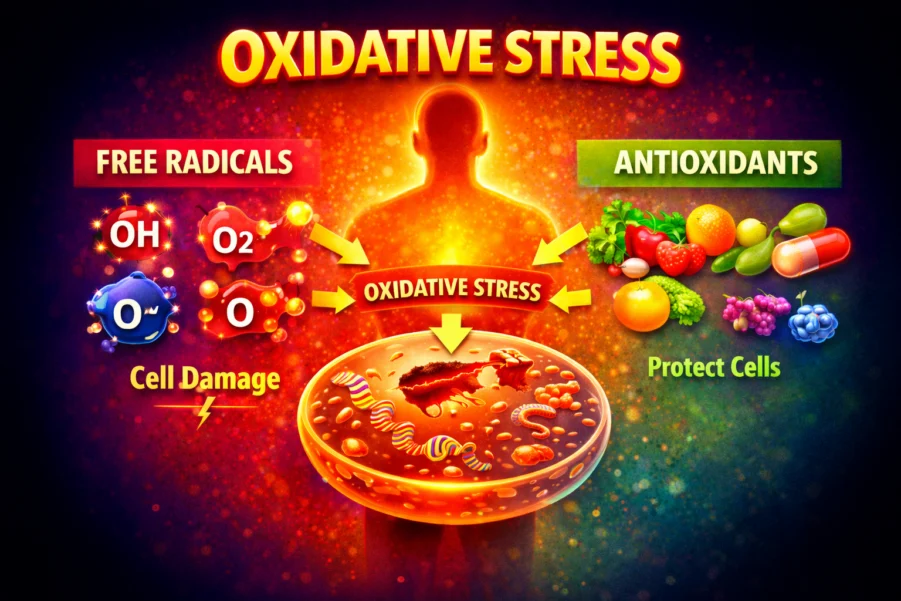
Oxidative stress represents a disturbance of the balance between the production of reactive oxygen species (ROS) and the body’s ability to neutralise them. It is essentially the predominance of free radicals in our body.
With the help of oxygen, our body produces energy from organic matter. During this internal combustion, oxygen free radicals are created alongside energy. These are highly reactive molecules that arise when they receive fewer electrons than they need, which makes them extremely reactive. In their effort to acquire the electrons they lack, they react with various substances in the cell, causing damage.
Under normal conditions, the body keeps free radicals under control through antioxidant mechanisms. When this balance is disturbed, oxidative stress arises.
Prolonged exposure to oxidative stress is associated with serious conditions such as:
- Cardiovascular disease and atherosclerosis
- Neurodegenerative diseases (Alzheimer’s, Parkinson’s)
- Cancer and type 2 diabetes
- Chronic inflammation and a weakened immune system
Moreover, according to scientific studies, oxidative stress is the most important cause of ageing. The antioxidant defence mechanisms become less effective after the age of 40, which makes assessing and addressing oxidative stress all the more important.
How the oxidative stress test (O.S.I.) is done
The laboratory assessment of oxidative stress is now carried out with specialised blood tests. Today we have methods that allow us to accurately estimate both the level of oxidative stress and the body’s “active protection” against free radicals.
The Oxidative Stress Index (O.S.I.) brings together in one value the information from two different assays: the d-ROMs test (derivatives of Reactive Oxygen Metabolites) and the PAT test (Plasma Antioxidant Test). Correlating these two values allows the intensity of oxidative stress to be determined precisely, providing valuable clinical information for healthy people and patients alike.
The test assesses specific parameters:
- Total antioxidant status (TAS)
- Glutathione peroxidase (GPx)
- Vitamins C and E
- Trace elements (selenium, zinc)
- Homocysteine
- Malondialdehyde (MDA)
It is particularly important that the history form is completed by the healthcare professional, as this is essential for a complete evaluation of the results. The results are usually available within 3 working days.
Alternatively, there is also a saliva-based test, a newer approach to assessing the state of one’s health in relation to oxidative stress.
How to interpret the results and take action
The Oxidative Stress Index (O.S.I.) plays a complementary role in clinical assessment and does not replace a diagnosis. Above all, it shows whether the oxidative mechanisms in the body outweigh the antioxidant ones.
In practice, the O.S.I. helps establish whether oxidative stress is an underlying pathophysiological mechanism in a clinical picture with no clear cause. Its clinical value is greatest when:
- There are multiple risk factors (metabolic, inflammatory)
- A holistic assessment is needed
- It is used comparatively, in repeated measurements
Elevated values indicate an increased oxidative load, but they do not constitute a diagnosis of disease. Furthermore, recent intake of antioxidants affects the results.
Therefore, after elevated O.S.I. values, the following are recommended:
- Improving your diet (more fruit and vegetables)
- Stopping smoking
- Adequate sleep
- Controlling inflammation
In cases of increased oxidative stress in semen, dietary supplements (antioxidants) are initially recommended for 4 to 6 weeks, followed by a repeat test. It is worth noting that antioxidants should not be taken without a prior measurement, as the balance may tip in the opposite direction.
Conclusion
In summary, oxidative stress is a silent threat to our health that affects every cell in the body. Understanding the balance between free radicals and antioxidant mechanisms plays a decisive role in preventing many serious diseases. The Oxidative Stress Index (O.S.I.) offers a reliable way of assessing this balance, without, however, being a stand-alone diagnostic tool.
After the test at the Mikrolab diagnostic centre and a detailed interpretation of the results, the person tested receives a personalised antioxidant regimen tailored to their body’s needs. At the same time, a specific schedule for follow-up testing is set, so that the response to the intervention can be assessed and the gradual restoration of the redox balance ensured.
The O.S.I. complements clinical assessment and gains greater value when used for comparative measurements over time. The results can guide targeted lifestyle changes, such as improving the diet with more fruit and vegetables, stopping smoking, adequate sleep and controlling inflammation.
Regular monitoring becomes particularly important after the age of 40, as the natural antioxidant defence mechanisms weaken over time. It should be stressed, however, that taking antioxidant supplements without a prior measurement may tip the balance in the opposite direction. This is why measuring oxidative stress and being guided by healthcare professionals are essential before any intervention.
Ultimately, managing oxidative stress is a personalised path of prevention and rebalancing. Through the correct interpretation of the results and organised follow-up, we can take targeted measures to reduce the oxidative load, improving quality of life and reducing the risk of serious disease in the future.