
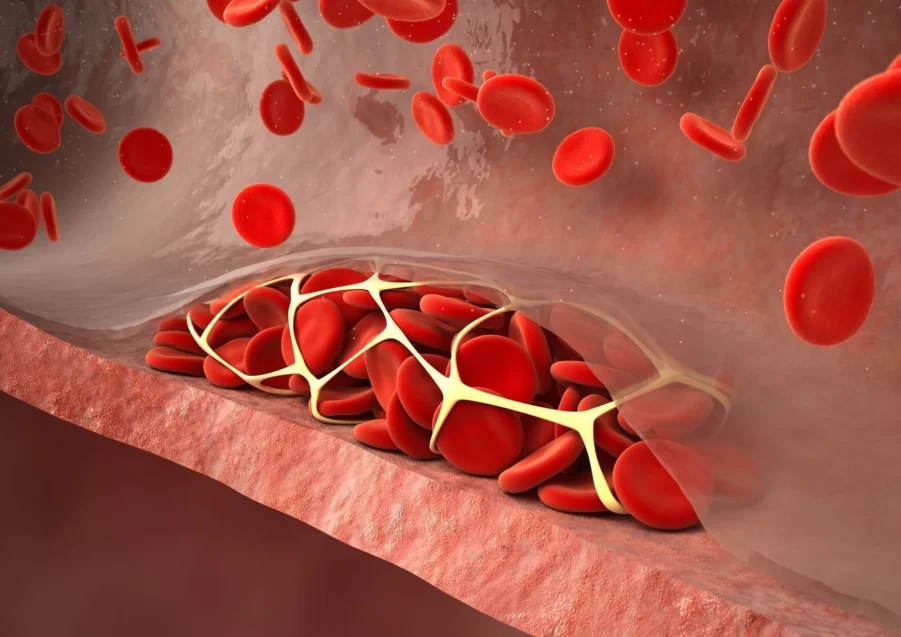
Thrombophilia
Thrombophilia is a person’s tendency to form blood clots (hypercoagulability, stasis of the blood). Its causes may be acquired or hereditary, or a combination of the two. A very large set of proteins and antibodies, clotting factors and key cells such as platelets all contribute to blood clotting. Any change in these components, defined as acquired causes, can produce a clotting disorder. Acquired causes also include various diseases that lead to clot formation, such as liver disease (since key proteins are synthesised in the liver), cancer, infections such as hepatitis, disseminated intravascular coagulation and others.
Besides the acquired causes, there is also a large set of hereditary genes, that is, traits a person is born with. Common hereditary thrombophilia genes are factor V (Leiden) G1691A,
- the prothrombin G20210A mutation
- mutations of the homocysteine gene (MTHFR C677T).
Studies have shown that 10% of the world’s population carries a hereditary thrombophilia gene, the most common being factor V Leiden and the prothrombin G20210A mutation.
A thrombotic event will not necessarily occur in someone who carries the gene, but they are at greater risk than someone who does not. What often aggravates the situation is the combination of two or three factors of hereditary and acquired origin. The most serious form of thrombosis is deep vein thrombosis and pulmonary embolism, which requires immediate anticoagulant treatment as it is life-threatening.
Proper laboratory testing gives us all the information needed to start treatment and prevent thrombotic events. One notable situation in which thrombophilia testing should be performed is pregnancy: during pregnancy several clotting factors rise physiologically, and testing is advisable to safeguard it.
Thrombophilia testing does not require fasting and can be done at any time of day. It includes the following tests:
- Complete blood count – platelets, PT, aPTT
- Homocysteine – vitamin B12 – folic acid
- Antithrombin III (blood concentration)
- Protein C
- Activated protein C resistance
- Protein S
- Anticardiolipin antibodies (IgG, IgM)
- Anti-β2 glycoprotein I antibodies (IgA, IgG, IgM)
- Lupus anticoagulant, factor V (Leiden) G1691A mutations
- Prothrombin G20210A mutation
- Homocysteine gene mutations (MTHFR C677T)
- GPIa and GPIIIa mutations
- PAI-1 polymorphisms [4G/5G, G/A (-844 bp)]
Our laboratory offers free home sample collection.
Contact us for more details and the cost of the test.





